How to relieve constipation in babies: a parent’s guide

Constipation baby

Quick Explanation

Worried about your constipated baby? Discover gentle home remedies, dietary tips, and learn the signs for when to call a doctor. Get expert advice.

Stage

0-1

Years

Reading time

5

minutes

mum and dad looking confused at a baby's nappy being changed

The ultimate baby poo checker

Scan, track and understand your baby's poos with our free AI poo checker tool with a visual guide on colour, consistency, what is normal and when to be concerned.

When your baby’s constipated, it can feel worrying to see them in pain or discomfort – especially if you’re a first-time parent. But rest assured that baby constipation is relatively common, and there are several things that you can do to ease the symptoms.

Here we’re looking at what causes constipation in babies, what the symptoms are, and some top tips for how to relieve constipation in babies quickly and gently – including baby massages and foods that can help get things moving. You’ll also find guidance on when it’s best to seek medical advice. 

Got questions about your baby’s poo? Poogle it! Try the poo checker

Favourites_Cards

Join Aptaclub for a chance to win a £100 John Lewis voucher, plus expert feeding advice, expert parenting tools, helpful checklists and the latest deals straight to your inbox.

Your email will be used to create your account and to recognise you when you contact us. We may also use your email to match data for research purposes.
Loading....
This field is required Please retype or use an alternative email address with a minimum of two letters, containing an @ symbol i.e. email@email.co.uk Your email has been verified. You can now register Please verify your email before submitting. Name validation https://bpi.briteverify.com/api/public/v1/fullverify 2b465552-a427-4a22-b5a8-aaba7770bf1d
Your password must be a minimum of 8 characters, with at least 1 letter, 1 number and 1 special character.
This field is required Please ensure your passwords match and contain a minimum of 8 characters, with at least 1 letter, 1 number and 1 special character.
Cow & Gate products excluding first infant milks and food for special medical purposes.
Please tick this box
Before we send you advice and information on infant feeding (for babies below 6 months), we're required to ask for your consent.

It looks as though you already have an account with us via [Aptaclub/C&G Babyclub] – please try your password for that account to login, or click 'forgot my password' to reset.

Please correct the errors in the form

By registering you're confirming you agree with our T&Cs and Privacy Policy. You can opt out anytime.

What causes constipation in babies?

Many possible things could leave you dealing with a constipated newborn or older baby. Here are some of the most common1.

Being dehydrated

If your baby has been poorly or teething, they may have been drinking less fluid, which could leave them a little dehydrated. Dehydration can cause constipation by making your baby’s poo harder and more difficult to pass.

If you’re exclusively breastfeeding, you could try offering your baby more frequent feeds to help them get more fluids.

When it comes to how to help a constipated baby who’s formula-fed, you could try giving them small amounts of cooled, boiled water between their usual feeds2. Weaned babies can have small sips of water with meals to help them stay hydrated3.

Changes in your baby’s diet

Changes in your baby’s diet – for example, moving from breastmilk to formula milk, or introducing solid foods for the first time – can upset their digestion at first. It can take some time for their body to get used to the change, and sometimes, this can lead to constipation. 

When making any changes to your baby’s diet - for example, if they’re ready for solid foods - take things gradually. This will give your baby’s body a chance to adjust. You can also use some of the gentle techniques below for how to relieve constipation in babies quickly if your little one needs a little help. 

If you’re thinking about changing your baby’s formula milk, or you’re introducing formula for the first time, always speak to your midwife or healthcare professional first.

Not getting enough fibre

Just like adults, babies need fibre to support their normal digestion. Once you start weaning your baby onto solid foods, they may become constipated if they’re not getting enough.

Fibre is found in lots of foods. Fresh, frozen, puréed, and chopped fruits and vegetables can all help pack your baby’s diet with the fibre they need and help prevent constipation.

Mother watching her baby play on a rocking toy

Learn why fibre is so important for your growing baby.

Is your baby keen to wean?

If your baby is around 6 months, they may be ready to try solid foods alongside their usual breastmilk or formula. Find everything you need to know about weaning, from how to tell your baby’s ready to what to feed them.

What are the signs your baby is constipated?

If you have a constipated newborn or older baby, they may show symptoms such as1:

  • Pooing less than 3 times per week
  • Struggling or straining to poo
  • Having poos that are bigger than usual, or having dry, pellet-like poos
  • Wind or poo that’s smellier than usual
  • A firm tummy
  • Being less hungry or grumpier than usual

When it comes to poo, what’s considered ‘normal’ can vary a lot between babies, just like it does for adults. Rest assured you’ll soon get used to what’s typical for your baby, and be able to spot the signs that they’re not feeling 100% themselves.

Mother watching her baby play on a rocking toy

The ultimate baby poo checker

Scan, track and understand your baby’s poos with our free poo checker tool. Get a visual guide on colour, consistency, what’s normal, and when to contact your healthcare professional.

Constipation in breastfed babies

Can breastfed babies get constipated? The simple answer is yes. However, breast milk is a natural laxative, meaning that it’s less common for breastfed babies to become constipated4,5, but it can still happen from time to time. 

Whilst some breastfed newborns will poo after every feed, as your baby grows, they can go as long as a whole week without having a poo. If your baby’s poo is soft, it’s unlikely that they’re constipated4.

Remember that if you’re breastfeeding, your baby won’t need anything other than breastmilk (including water) until they’ve started eating solid foods, when they’re around 6 months old3.

Constipation in formula-fed babies

Constipation tends to be more common in formula-fed babies than in those who exclusively breastfeed4,5. If you’ve introduced formula into your baby’s feeding routine, you may notice a change in their poos as their tummy adapts.

When preparing a formula feed, be sure to follow the instructions on the pack exactly, so you always use the correct number of scoops and the correct amount of water. This is because too little formula milk powder won’t provide the nutrients your baby needs, and too much can cause constipation or make your baby ill4.

Constipation in weaned babies

If your baby is a little bit older and has started their weaning journey, you might find that the change in their diet leads to a change in their toilet habits too. 

It’s important that your baby gets enough fibre in their diet, so you could try giving them more fibre-packed foods like cereals, fruit and vegetables alongside breastfeeding or formula milk to try to move things along2. Sips of water with meals can help, too. 

Let’s take a look at some more gentle home remedies for how to relieve constipation in babies.

How to help a constipated baby: gentle home remedies

If you’re wondering how to relieve constipation in babies quickly, rest assured that you’re not alone, and there are a few gentle home remedies you can try when it comes to baby constipation relief.

Remember that all babies are different, and while you should hopefully see an improvement in a couple of days, constipated newborns and babies can sometimes take a little longer to get back on that regular track.

Dietary changes to help your baby poo

Once they’ve started weaning, there’s a wide variety of tasty foods your baby can eat to both help prevent constipation and ease the symptoms.

Fruit

Some fruits contain sorbitol, which is a polyhydric alcohol, derived from glucose that acts as a natural laxative and can help ease constipation. Fruits high in sorbitol include6:

  • Apples
  • Apricots
  • Grapes and raisins
  • Peaches
  • Pears
  • Plums
  • Prunes

Depending on how far along your baby is on their weaning journey, you could purée high-sorbitol fruits or cut them up into small pieces before offering them. Dried fruits can contain 5-10 times more sorbitol6, but they’re also often high in sugar, so only offer them in moderation and at mealtimes7.

Vegetables

Many vegetables are also high in fibre, and can help ease or prevent constipation in your weaning baby. 

These include8:

  • Carrots
  • Swede
  • Peas
  • Avocado
  • Cooked broccoli and cauliflower 

Vegetables also make tasty purées for babies trying solid foods for the first time. You can offer a variety of puréed veg in your baby’s weaning diet to give them lots of flavours and textures, as well as sources of fibre to try.

If you’re baby-led weaning, offer your baby soft-cooked vegetable sticks to munch on.

Other baby foods that help with constipation

Fruits and vegetables aren’t the only foods that can help relieve constipation in babies. Starchy foods like cereals, wholemeal bread, pasta and rice are also great sources of fibre, which is really important for a healthy and balanced weaning diet.

Wholegrain foods (like brown rice and wholemeal bread) are particularly high in fibre. While, in theory, this is great news if you’re wondering how to help a constipated baby, it can also mean they feel full before they’ve got all the essential nutrients they need from their food. Offering some wholegrains is fine, but you should avoid giving your baby only wholegrain starchy foods until after their second birthday9.

Physical movements and massage techniques

Fruit, veg, and other fibre-filled foods are great for weaned babies. But how can you help a newborn with constipation? 

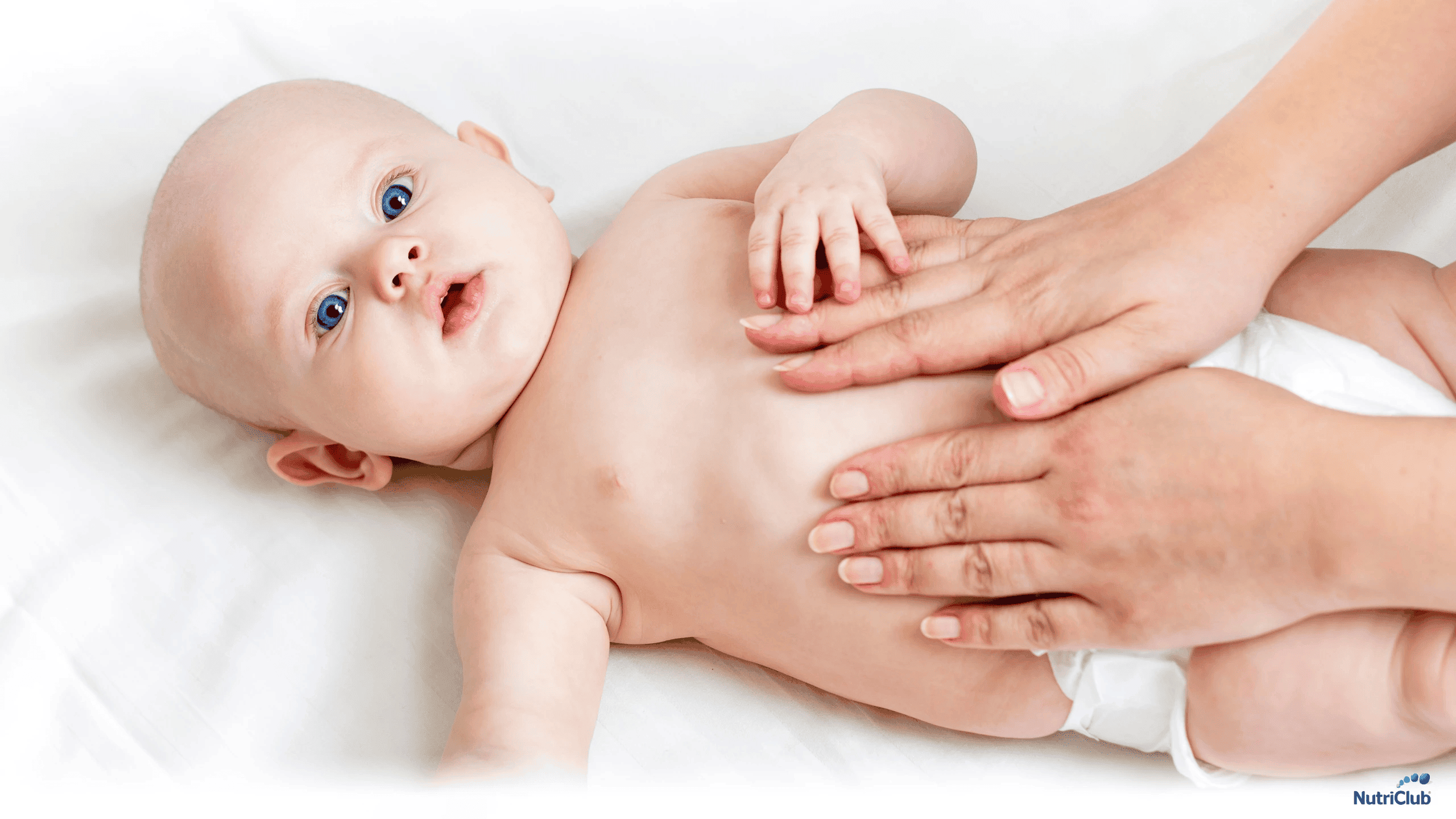
When exploring how to help a newborn poop, try these gentle movements and massages to help your baby’s digestion. 

  • Gently move your baby’s legs as if they’re riding a bicycle while they’re lying down1.
  • If your baby’s happy lying down, you can give them a tummy massage with the pads of your fingers. Gently stroke their tummy in a clockwise direction, avoiding their rib cage and lightening your pressure over their bladder area10.
  • Encourage plenty of tummy time to help your baby’s system get moving!

Your healthcare professional can give you more advice about how to help your constipated newborn if you need it.

Did you know?

Massaging your baby can have lots of other benefits besides relieving constipation, like supporting relaxation, bonding, deeper sleep, learning and development10.

When should you call a doctor for your baby’s constipation?

Often, constipated newborns and older babies can be treated at home. But sometimes, you might need to visit a GP for some additional advice and support. 

Contact your GP if your baby4,5:

  • Hasn’t had a poo for 2-3 days
  • Seems very distressed
  • Isn’t gaining weight
  • Has very pale poos
  • Has blood in their poo
  • Is being sick a lot
  • Has a very hard or swollen tummy

Remember, you know your baby best, so trust your instincts. If you’re worried, it’s always best to talk to a healthcare professional for advice about how you can help a newborn with constipation. 

Medical treatments for infant constipation

If your baby is still constipated after you’ve tried some simple home remedies, your doctor may prescribe laxatives called Macrogols to soften your baby’s poos and make them easier to pass11.

Always follow your GP or pharmacist’s instructions when giving your baby any medicine, and never give any medication to your baby without first speaking to your healthcare professional.

Frequently asked questions

How much cooled boiled water should babies with constipation have?

If your baby is exclusively breastfed, they won’t need any other liquids (including water) until they’re eating solid foods3.

If your baby is under six months old and is formula-feeding, you can offer small sips of cooled boiled water in addition to their usual bottle-feeding routine if they’re experiencing constipation.

Once your baby has started weaning, they can have sips of water at mealtimes. If they’re over six months old, you won’t need to boil the water first3.

Why shouldn’t you give your baby sugar water for constipation?

It’s never advisable to give a constipated newborn or baby sugar water. In fact, you should avoid adding sugar to your child’s diet in general due to the risk of tooth decay12.

Instead, you can offer more fluids in the form of:

  • Additional feeds for exclusively breastfed babies
  • Small amounts of cooled, boiled water between feeds for formula-fed babies
  • Sips of water with meals for babies who are weaning

Can you give a baby prune juice for constipation?

You may have heard that prune juice is an effective way of relieving constipation in babies. This is because of the natural laxative, sorbitol, which is found in prunes6. However, healthcare professionals advise against giving your baby fruit juices if they’re under 12 months old3.

If you do choose to give your baby prune juice (or any other fruit juice), always dilute it to one part juice, 10 parts water, and only offer it during mealtimes3.

Your baby can also benefit from the laxative effect of prunes by eating them chopped or puréed as part of their weaning diet.

Are glycerin suppositories safe to use at home for my baby?

Laxatives, such as glycerin suppositories, should only be used when prescribed by your doctor. In general, they’re not recommended for babies who haven’t been weaned13.

  1. NHS Best Start in Life. Constipation and breastfeeding [online] Available at https://www.nhs.uk/best-start-in-life/baby/feeding-your-baby/breastfeeding/breastfeeding-challenges/constipation/ [Accessed November 2025]
  2. NHS Best Start in Life. Constipation and bottle feeding [online] Available at https://www.nhs.uk/best-start-in-life/baby/feeding-your-baby/bottle-feeding/bottle-feeding-challenges/constipation-and-bottle-feeding/ [Accessed November 2025]
  3. NHS (2022). Drinks and cups for babies and young children [online] Available at https://www.nhs.uk/baby/weaning-and-feeding/drinks-and-cups-for-babies-and-young-children/ [Accessed November 2025]
  4. HSE (2021). Constipation in babies (0 to 6 months) [online] Available at https://www2.hse.ie/conditions/constipation-children/constipation-in-babies-0-to-6-months/ [Accessed November 2025]
  5. NHS. How to make up baby formula [online 2023]. Available at https://www.nhs.uk/baby/breastfeeding-and-bottle-feeding/bottle-feeding/making-up-baby-formula/. [Accessed November 2025]
  6. NHS Manchester University. Bowel care [online] Available at https://mft.nhs.uk/app/uploads/sites/4/2024/04/SMPIL-24-031-Bowel-Care-Leaflet.pdf [Accessed November 2025]
  7. NHS (2022). 5 a day: what counts? [online] Available at https://www.nhs.uk/live-well/eat-well/5-a-day/5-a-day-what-counts/ [Accessed November 2025]
  8. NHS West Suffolk (2021). Fibre [online] Available at https://www.wsh.nhs.uk/CMS-Documents/Patient-leaflets/ColorectalandStomaCare/5147-2Fibre.pdf [Accessed November 2025]
  9. NHS (2023). What to feed young children [online] Available at https://www.nhs.uk/baby/weaning-and-feeding/what-to-feed-young-children/ [Accessed November 2025]
  10. Tommy's. Baby massage tips and how to get started [online] Available at https://www.tommys.org/pregnancy-information/blogs-and-stories/im-pregnant/tommys-midwives/baby-massage [Accessed November 2025]
  11. NHS Gateshead Health. Constipation [online] Available at https://www.gatesheadhealth.nhs.uk/wp-content/uploads/2024/03/Constipation-Advice-Leaflet.pdf [Accessed November 2025]
  12.  NHS (2022). Foods to avoid giving babies and young children [online] Available at https://www.nhs.uk/baby/weaning-and-feeding/foods-to-avoid-giving-babies-and-young-children/ [Accessed November 2025]
  13. NHS (2022). Laxatives: considerations [online] Available at https://www.nhs.uk/medicines/laxatives/considerations/ [Accessed November 2025]

Your baby's future health begins here

At Aptaclub, we believe that experience helps to build resilience; and that each new encounter, whether in pregnancy or after birth, can shape your baby’s future development. With our scientific expertise and one-to-one round the clock support, we can help you and your baby embrace tomorrow.

mom and baby

Need some help?

You can get quick answers to common questions in our FAQs.

Alternatively, if you need help with general pregnancy or baby advice, or maybe on using or ordering our products - our expert team are always on hand to talk about feeding your baby. 


Share this article

Favourites_Cards

Join Aptaclub for a chance to win a £100 John Lewis voucher, plus expert feeding advice, expert parenting tools, helpful checklists and the latest deals straight to your inbox.

Your email will be used to create your account and to recognise you when you contact us. We may also use your email to match data for research purposes.
Loading....
This field is required Please retype or use an alternative email address with a minimum of two letters, containing an @ symbol i.e. email@email.co.uk Your email has been verified. You can now register Please verify your email before submitting. Name validation https://bpi.briteverify.com/api/public/v1/fullverify 2b465552-a427-4a22-b5a8-aaba7770bf1d
Your password must be a minimum of 8 characters, with at least 1 letter, 1 number and 1 special character.
This field is required Please ensure your passwords match and contain a minimum of 8 characters, with at least 1 letter, 1 number and 1 special character.
Cow & Gate products excluding first infant milks and food for special medical purposes.
Please tick this box
Before we send you advice and information on infant feeding (for babies below 6 months), we're required to ask for your consent.

It looks as though you already have an account with us via [Aptaclub/C&G Babyclub] – please try your password for that account to login, or click 'forgot my password' to reset.

Please correct the errors in the form

By registering you're confirming you agree with our T&Cs and Privacy Policy. You can opt out anytime.

x