Is your baby constipated? Decoding hard stools and when to seek help

Constipation baby

Quick Explanation

Learn about hard stools and what baby constipation may look like: Poogle it! Plus, some gentle remedies to support your baby's gut health and comfort.

Stage

0-1

Years

Reading time

5

minutes

mum and dad looking confused at a baby's nappy being changed

The ultimate baby poo checker

Scan, track and understand your baby's poos with our free AI poo checker tool with a visual guide on colour, consistency, what is normal and when to be concerned.

You change your little one's nappy, and... nothing. Or worse, you find tiny, hard pellets, and your baby is straining, red-faced, and clearly uncomfortable. It’s a moment that can instantly trigger a wave of parental anxiety. "Is my baby constipated?" you wonder, reaching for your phone. Infant constipation is incredibly common and can be a real worry for parents1. But what if you could search for some quick answers about your baby's nappy?

 With the Aptaclub AI Poo Checker, you can get instant results on your baby's poo colour and consistency simply by uploading a photo of their poo. It’s designed to help you decode those tricky nappy contents and get reassurance.

So, if you've got questions about your baby's poo, you can Poogle It!

Let's dive into the signs of baby constipation, explore some gentle remedies, and learn when it's time to have a chat with your GP.

It's easy to assume constipation simply means infrequent pooing. However, when it comes to babies, it's also about the consistency of their stool.  A baby might poo every few days, or even once a week, and still be perfectly fine, as long as their poo is soft and easy to pass2. The key indicator for baby constipation is usually hard baby poo.


Favourites_Cards

Join Aptaclub for a chance to win a £100 John Lewis voucher, plus expert feeding advice, expert parenting tools, helpful checklists and the latest deals straight to your inbox.

Your email will be used to create your account and to recognise you when you contact us. We may also use your email to match data for research purposes.
Loading....
This field is required Please retype or use an alternative email address with a minimum of two letters, containing an @ symbol i.e. email@email.co.uk Your email has been verified. You can now register Please verify your email before submitting. Name validation https://bpi.briteverify.com/api/public/v1/fullverify 2b465552-a427-4a22-b5a8-aaba7770bf1d
Your password must be a minimum of 8 characters, with at least 1 letter, 1 number and 1 special character.
This field is required Please ensure your passwords match and contain a minimum of 8 characters, with at least 1 letter, 1 number and 1 special character.
Cow & Gate products excluding first infant milks and food for special medical purposes.
Please tick this box
Before we send you advice and information on infant feeding (for babies below 6 months), we're required to ask for your consent.

It looks as though you already have an account with us via [Aptaclub/C&G Babyclub] – please try your password for that account to login, or click 'forgot my password' to reset.

Please correct the errors in the form

By registering you're confirming you agree with our T&Cs and Privacy Policy. You can opt out anytime.

What is constipation in babies? It's more than just infrequent poo

Infant constipation occurs when a baby’s bowel movements become infrequent and difficult to pass. The baby’s stool itself is typically hard, dry, and may resemble small pellets or balls1. This can be painful for your baby and lead to discomfort. Understanding the normal variations in baby poo is crucial to identifying when things have changed.

Why is my baby constipated? Common causes behind those hard stools

Several factors can contribute to constipation in babies. It's often linked to dietary changes or factors affecting their developing digestive system.

Changes in Diet:

  • Switching Formula: If you've recently changed your baby's infant formula, or switched from breastmilk to formula, this can sometimes lead to constipation. Different formulas can have varying effects on a baby's digestive system3.
  • Introducing Solids (Weaning): This is a very common time for weaning constipation to appear. As babies start solid foods, their bodies adjust to processing fibre and different food types. Sometimes constipation happens when babies don’t drink enough fluids, especially if they’ve recently started eating more fibre. Fluids from breastmilk or water help the extra fibre move smoothly through their system4.

Dehydration: Not getting enough fluids can make your baby’s stool harder and more difficult to pass. This is especially true if a baby has been unwell with a fever or has experienced vomiting.

Medical Conditions: While less common, underlying medical conditions can sometimes cause constipation. This is why it's important to consult a paediatrician if constipation is persistent or severe.

The tell-tale signs: How to spot constipation in your baby

Being a poo expert is part and parcel of parenting. Here's what to look for if you suspect baby constipation:

Poo consistency: The Bristol Stool Chart for Babies (simplified!)

When considering your baby's nappy contents, think about the Bristol Stool Chart, but adapted for little ones. For babies, anything resembling small, hard pellets, or firm, lumpy sausage-shaped  poo that's difficult to pass, could be an indication of constipation. Normal baby poo, even if infrequent, should be soft and relatively easy to pass5.

Poo frequency: How often should your baby poo?

While consistency is key, a sudden, significant decrease in frequency can also be a sign, especially if accompanied by hard stools.

  • Breastfed Babies: It's common for breastfed babies to poo less frequently after the first few weeks, sometimes going days between bowel movements. This is normal if the poo is soft2.
  • Formula-Fed Babies: Formula-fed babies typically poo once a day or every other day. If a formula-fed baby goes more than two or three days without a soft stool, it's worth monitoring closely for other signs of constipation.

Other symptoms of baby constipation

It's not just about what's in the nappy. Look for these other signs that your baby might be struggling with constipation:

  • Baby straining to poo: They might appear to be finding it difficult or painful to pass a stool or they may pass stools that are larger than usual1.
  • Grumpy and tired: Your baby might be irritable, fussy, or seem to be lacking energy1.
  • Hard tummy: Their tummy might feel hard to the touch1.
  • Poor appetite: They may not be as interested in feeding as usual1.
  • Small amount of blood: Occasionally, straining to pass a hard stool can cause a tiny anal fissure (a little crack in the delicate skin at the opening of their baby bottom), leading to a small streak of blood on the outside of the poo6. This needs a doctor's review. 
  • Foul-smelling poo or wind: Their stool and wind may by unusually smelly1.

If your baby is showing any of the above symptoms, it’s a good idea to talk to your health visitor or GP. They’ll be able to provide you with guidance on how to manage baby constipation and advise you as to whether any treatment is required.

If your baby is irritable, has prolonged and intense crying and seems uncomfortable, this could also be a sign of colic. So always speak with your healthcare professional if you are worried about your baby's symptoms10.

Constipation in breastfed babies

Can breastfed babies get constipated? The simple answer is yes. Whilst constipation is rare in babies who are solely breastfed, it can still happen9.

Remember that if you’re breastfeeding, your baby won’t need anything other than breastmilk, including water, until they've started eating solid foods, and it’s recommended that this doesn’t happen until your baby is around 6 months of age7

Constipation in formula fed babies

Constipation tends to be more common in formula fed babies than in those who are breastfeeding exclusively. If you’ve recently started giving your baby formula milk and you notice a change in their bowel movements, it’s likely that their tummy is simply adapting to the change1.

When you’re formula feeding your baby, it’s very important to follow the instructions provided on the pack exactly. You should never reduce or increase the amount of powder or add extra water to their your  bottle1. Too little powder won’t give your baby the nourishment they need, while too much powder makes the formula too concentrated. This can be hard on your baby’s small body and may mean they get more nutrients than their body can safely handle.8

If your baby is formula feeding, and is experiencing constipation, you could try giving them sips of water in between their normal feeds if your baby is over 6 months old11. Speak with your healthcare professional for advice.

Gentle remedies for baby constipation: What you can do at home

Wondering how to help relieve constipation symptoms in babies? If your baby is showing mild signs of constipation (and you've ruled out anything serious with your GP), there are several gentle home remedies you can try.

Movement and massage: Getting things toing naturally

  • Bicycle legs: Lie your baby on their back and gently move their legs in a cycling motion towards their tummy. This can help stimulate their bowels1.
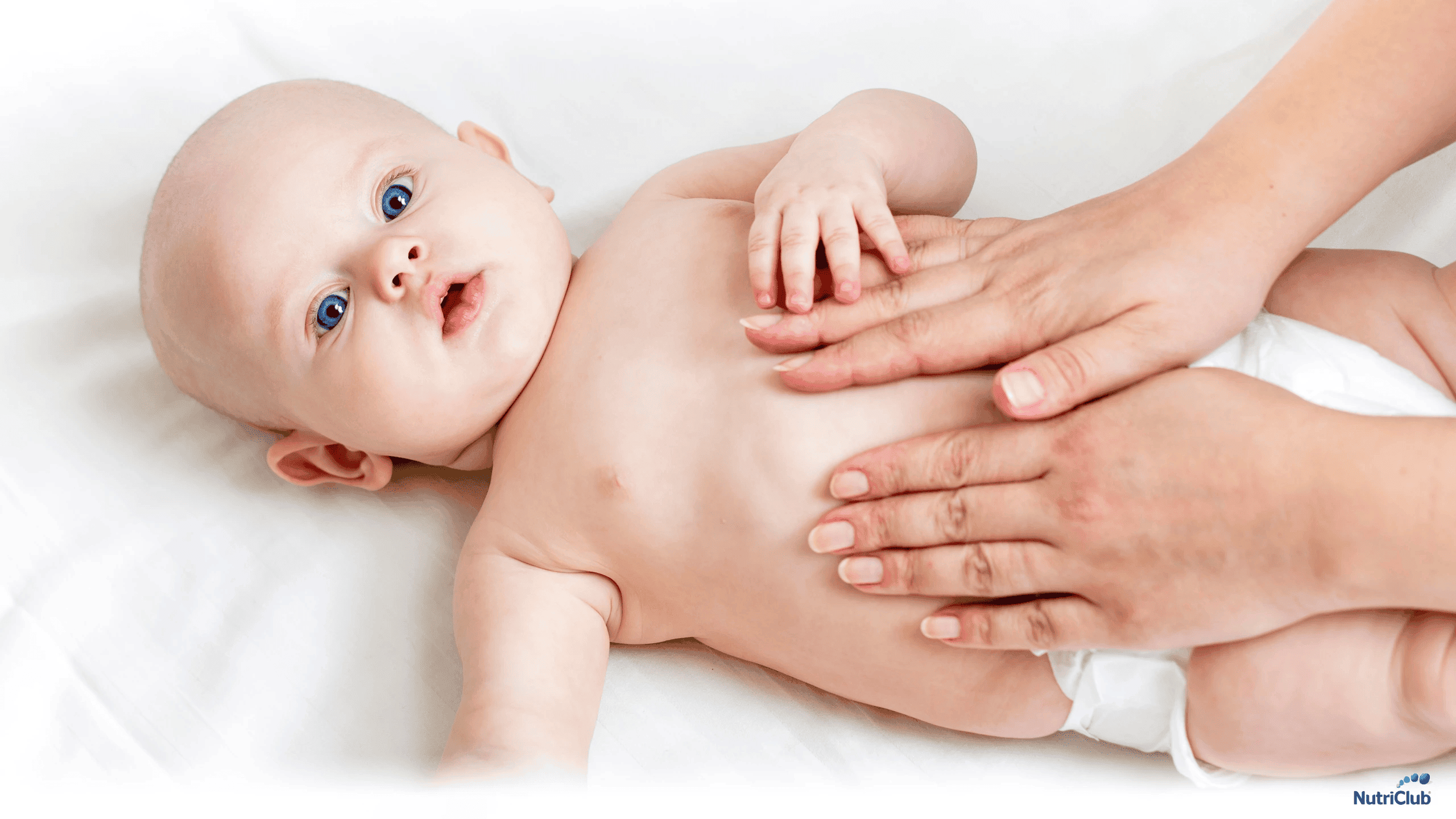
  • Gentle tummy massage: Use your fingertips to gently massage your baby's tummy in a clockwise direction9.
  • Warm bath: A relaxing warm bath can help ease discomfort and encourage a bowel movement.

What can I give a constipated baby?

For older babies who have started solids, a few dietary adjustments might help:

  • Increased fluids: Ensure your baby is well-hydrated. If formula-feeding, make sure formula is prepared correctly. For babies 6 months+, offer sips of water between feeds11.
  • High-fibre veggies: Offer high-fibre vegetables like broccoli, peas, and spinach (if already introduced) with their meals4.
  • Fibre fruits: Introduce or increase intake of fruits rich in fibre, like prunes, pears, peaches, and plums9. Offered mashed, or even sliced into long, finger-sized pieces after your baby is used to different textures, these can gently ease constipation when offered alongside meals.

Remember, always consult your doctor before making significant changes to your baby’s diet, especially for very young infants.

Other baby foods that help with constipation

  • When it comes to avoiding or easing the symptoms of baby constipation, fruit and vegetables aren’t the only things that can help4.
  • Starchy foods like cereals, wholemeal bread, pasta and rice are also a source of fibre, which is really important for a healthy and balanced weaning diet4

However, bear in mind that wholegrain foods such as brown rice, wholemeal pasta and wholemeal bread are fibre-rich foods for children. For babies, it’s best to offer a mix of wholegrain, wholemeal, and white varieties of rice and pasta to balance their fibre intake and make sure their tiny tummies don’t fill up too quickly during meals8.

When to call the GP: Don't hesitate to seek medical advice

While many instances of baby constipation are mild and resolve with home remedies, some situations require prompt medical attention.

Consult your GP or seek medical advice if:

  • Your baby is under 6 weeks old and appears constipated.
  • Constipation is persistent, lasting more than a few days, despite home remedies.
  • Your baby is in severe pain or distress when trying to poo, or your baby is not pooping at all.
  • There is any blood in their poo (even a small streak).
  • Your baby is refusing feeds, vomiting, or seems unusually unwell.
  • You are concerned about their growth or general well-being.

Poo questions answered: The Aptaclub AI Poo Checker

Dealing with digestive issues of your baby can be stressful, and parental anxiety around nappy contents is very real. This is where Aptaclub's AI Poo Checker* steps in as your trusted companion.

Our unique, AI-powered web tool offers instant analysis of your baby's poo just by uploading a photo from your phone. Built on a huge database of 3.5 million nappies and developed by our experts following 50 years of infant nutrition research, it gives you reliable answers and stool charts for normal baby poop characteristics, including infant stool consistency and colour. It helps you effortlessly record changes over time and provides answers within seconds.

Don't let the worry of baby constipation linger. Our tool makes it easy to track changes and gain parental reassurance, supporting confident conversations with your doctor. And remember, if you've got questions about your baby's poo, Poogle It! 

*The Aptaclub AI Poo Checker is not a diagnostic tool and does not provide medical insights about your baby’s digestive health. It does not replace the advice of a healthcare professional.

  1. National Health Service (NHS). Constipation and bottle feeding. Available at: https://www.nhs.uk/start-for-life/baby/feeding-your-baby/bottle-feeding/bottle-feeding-challenges/constipation-and-bottle-feeding/  (Accessed 22 July 2025).
  2. National Health Service (NHS). How to change your baby’s nappy. Available at: https://www.nhs.uk/baby/caring-for-a-newborn/how-to-change-your-babys-nappy/  (Accessed 22 July 2025).
  3. Otten, L., et al. (2023). Gastrointestinal Tolerance of an Infant Formula Manufactured from Extensively Hydrolysed Protein in Healthy Term Infants. Nutrients, 15(21), 4674. Available at: https://www.mdpi.com/2072-6643/15/21/4674 (Accessed 22 July 2025).
  4. National Health Service (NHS). Constipation in infants and children. Available at: https://www.mkuh.nhs.uk/patient-information-leaflet/constipation-in-infants-and-children (Accessed 01 October 2025).
  5. Children’s Hospital Colorado. Baby Poop Guide. Available at: https://www.childrenscolorado.org/just-ask-childrens/articles/baby-poop-guide/ (Accessed 4 July 2025).
  6. National Health Service (NHS). Baby Poo and Wee. Available at: https://derbyshirefamilyhealthservice.nhs.uk/our-services/0-5-years/babies-health-and-wellbeing/baby-poo-wee (Accessed 22 July 2025).
  7. National Health Service (NHS). Drinks and cups for babies and young children. Available at: https://www.nhs.uk/baby/weaning-and-feeding/drinks-and-cups-for-babies-and-young-children/ (Accessed 2 September 2025)
  8. National Health Service (NHS). What to feed young children. Available at: https://www.nhs.uk/baby/weaning-and-feeding/what-to-feed-young-children/ (Accessed 2 September 2025)
  9. National Health Service (NHS). Constipation and breastfeeding. Available at: https://www.nhs.uk/start-for-life/baby/feeding-your-baby/breastfeeding/breastfeeding-challenges/constipation/ (Accessed 1 October 2025)
  10. Aptaclub. Colic in babies. Available at: https://www.aptaclub.co.uk/feeding/feeding-issues/special-conditions/colic-in-babies.html (Accessed 1 October 2025)
  11. National Health Service (NHS). Constipation in children. Available at: https://www.nhs.uk/baby/health/constipation-in-children/ (Accessed 22 October 2025)

Disclaimer: Aptaclub wants to empower parents with the knowledge and confidence to understand their baby's poo better. This information is for educational purposes and not a substitute for professional medical advice. Every child is different, always consult your doctor before changing your baby’s diet.

mom and baby

Need some help?

You can get quick answers to common questions in our FAQs.

Alternatively, if you need help with general pregnancy or baby advice, or maybe on using or ordering our products - our expert team are always on hand to talk about feeding your baby. 


Share this article

Favourites_Cards

Join Aptaclub for a chance to win a £100 John Lewis voucher, plus expert feeding advice, expert parenting tools, helpful checklists and the latest deals straight to your inbox.

Your email will be used to create your account and to recognise you when you contact us. We may also use your email to match data for research purposes.
Loading....
This field is required Please retype or use an alternative email address with a minimum of two letters, containing an @ symbol i.e. email@email.co.uk Your email has been verified. You can now register Please verify your email before submitting. Name validation https://bpi.briteverify.com/api/public/v1/fullverify 2b465552-a427-4a22-b5a8-aaba7770bf1d
Your password must be a minimum of 8 characters, with at least 1 letter, 1 number and 1 special character.
This field is required Please ensure your passwords match and contain a minimum of 8 characters, with at least 1 letter, 1 number and 1 special character.
Cow & Gate products excluding first infant milks and food for special medical purposes.
Please tick this box
Before we send you advice and information on infant feeding (for babies below 6 months), we're required to ask for your consent.

It looks as though you already have an account with us via [Aptaclub/C&G Babyclub] – please try your password for that account to login, or click 'forgot my password' to reset.

Please correct the errors in the form

By registering you're confirming you agree with our T&Cs and Privacy Policy. You can opt out anytime.

x